Fleet Safety Program Assessment
Course Overview
A successful fleet safety program requires more than maintaining vehicles and ensuring drivers follow traffic laws. Employers must establish clear policies, evaluate driver performance, identify operational risks, and maintain effective procedures that promote safe vehicle operations.
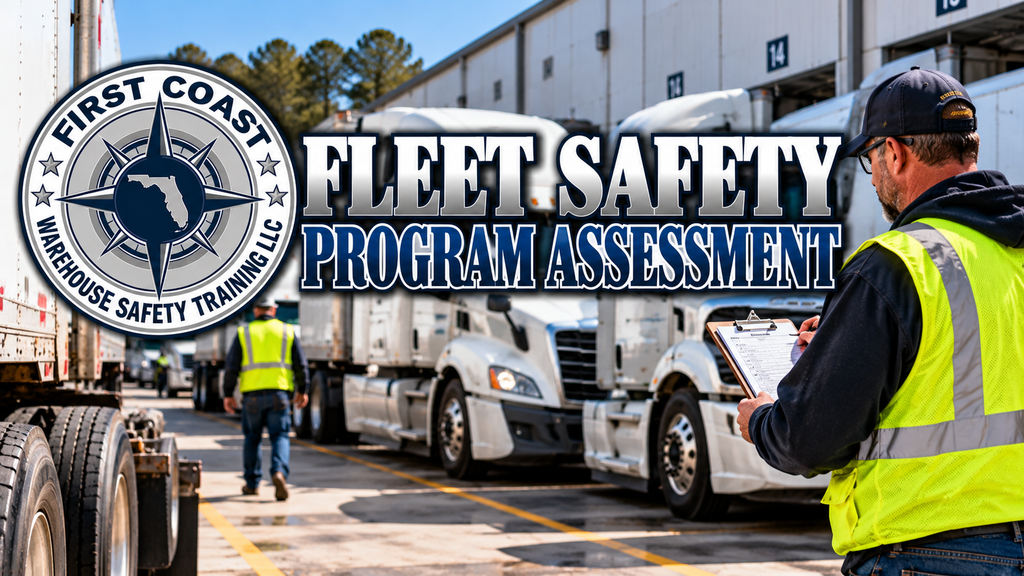
First Coast Warehouse Safety Training’s Fleet Safety Program Assessment course provides fleet managers, transportation supervisors, safety professionals, and business owners with an understanding of how to evaluate the effectiveness of an organization’s fleet safety program.
This course examines the essential components of fleet safety management, including driver qualifications, vehicle inspections, preventive maintenance, accident investigation, regulatory compliance, driver performance monitoring, and organizational safety responsibilities.
Participants will learn how to recognize weaknesses in existing fleet safety programs, evaluate current practices, and develop recommendations that support safer operations and continuous improvement.
What Students Will Learn
Upon completion of this course, participants will be able to:
- Understand the purpose and essential components of an effective fleet safety program.
- Evaluate organizational fleet safety policies and procedures.
- Identify management responsibilities for driver safety and regulatory compliance.
- Assess driver qualification, selection, onboarding, and training practices.
- Understand the importance of monitoring driver performance and unsafe driving behaviors.
- Evaluate vehicle inspection and preventive maintenance programs.
- Recognize the importance of accident reporting, investigation, and corrective action.
- Identify common fleet safety risks associated with distracted driving, speeding, fatigue, and aggressive driving.
- Understand the role of Hours of Service (HOS) regulations and Electronic Logging Devices (ELDs) where applicable.
- Recognize the importance of maintaining accurate driver and vehicle records.
- Evaluate the effectiveness of disciplinary procedures, coaching, and driver accountability.
- Develop practical recommendations for improving fleet safety performance.
Who Should Take This Course?
This training is intended for:
- Fleet managers and transportation supervisors
- Business owners operating company vehicles
- Safety directors and safety coordinators
- Operations managers
- Dispatch and logistics supervisors
- Warehouse and distribution center managers
- Human resources personnel involved in driver qualification
- Individuals responsible for evaluating or improving fleet safety programs
Key Areas of Fleet Safety Assessment
Fleet Safety Policies and Management Responsibilities
An effective fleet safety program begins with clear management expectations and written policies.
Participants will learn how to evaluate organizational safety policies, management involvement, employee responsibilities, and the procedures used to communicate safety expectations throughout the organization.
Driver Qualification and Training
Driver qualification and training are essential components of fleet risk management.
This section examines driver selection practices, qualification documentation, motor vehicle record reviews, orientation programs, continuing education, and performance evaluations.
Participants will learn how to identify gaps in driver training and determine whether existing practices adequately address operational risks.
Vehicle Inspections and Preventive Maintenance
Vehicle condition directly affects fleet safety.
Participants will examine procedures for vehicle inspections, defect reporting, maintenance scheduling, repair documentation, and removing unsafe vehicles from service.
The course emphasizes the importance of identifying mechanical problems before they contribute to an accident or equipment failure.
Driver Performance and Risk Identification
Fleet safety programs must address unsafe driving behaviors before they result in serious incidents.
Participants will learn how to evaluate driver performance using available information such as accident histories, inspection findings, driving observations, and applicable telematics data.
Common risk factors include speeding, distracted driving, following too closely, fatigue, improper backing, and failure to follow established procedures.
Accident Investigation and Corrective Action
An effective fleet safety assessment includes reviewing how an organization responds to vehicle accidents and near misses.
Participants will examine accident reporting procedures, investigation practices, contributing factors, documentation, and corrective action processes.
The course emphasizes identifying underlying causes rather than simply assigning blame.
Regulatory Compliance and Documentation
Fleet operations may be subject to federal and state transportation regulations depending on vehicle type, weight, use, and operating conditions.
Participants will receive an overview of applicable Federal Motor Carrier Safety Administration (FMCSA) requirements, including:
- Driver qualification requirements
- Hours of Service regulations
- Electronic Logging Device requirements
- Vehicle inspection, repair, and maintenance requirements
- Accident register requirements
- Drug and alcohol testing requirements for covered operations
- Recordkeeping and documentation responsibilities
The course explains that regulatory requirements vary depending on the type of fleet and whether vehicles are subject to commercial motor vehicle regulations.
Conducting a Fleet Safety Program Assessment
Participants will learn a structured approach to evaluating an existing fleet safety program.
The assessment process includes:
- Reviewing current fleet safety policies and procedures.
- Evaluating driver qualification and training records.
- Examining vehicle inspection and maintenance practices.
- Reviewing accident histories and identifying recurring trends.
- Assessing driver performance monitoring and corrective action procedures.
- Identifying weaknesses in management oversight and accountability.
- Developing recommendations for improving safety performance.
- Establishing measurable goals and follow-up procedures.
The objective is to provide participants with a practical understanding of how to identify program weaknesses and prioritize corrective actions.
Applicable Regulatory Standards
Depending on fleet operations, the course introduces relevant requirements under:
- 49 CFR Part 382 — Controlled Substances and Alcohol Use and Testing
- 49 CFR Part 383 — Commercial Driver’s License Standards
- 49 CFR Part 390 — Federal Motor Carrier Safety Regulations, General
- 49 CFR Part 391 — Qualifications of Drivers
- 49 CFR Part 392 — Driving of Commercial Motor Vehicles
- 49 CFR Part 395 — Hours of Service of Drivers
- 49 CFR Part 396 — Inspection, Repair, and Maintenance
Applicable OSHA workplace safety requirements and state transportation regulations may also be discussed where relevant.
This course is designed to support fleet safety program evaluation and does not replace a formal regulatory compliance audit.
Course Completion and Certificate
Participants must complete the required training material and successfully pass the final examination with a minimum score of 80%.
Upon successful completion, participants will receive a Certificate of Completion from First Coast Warehouse Safety Training.
This course provides educational instruction in fleet safety program assessment. Completion does not constitute certification of an organization’s fleet safety program or confirmation of regulatory compliance.
Training Services
First Coast Warehouse Safety Training provides practical safety education and training support for employers, supervisors, and organizations throughout Northeast and Central Florida and South Georgia.
Our goal is to help organizations strengthen fleet safety management, improve driver accountability, identify operational risks, and develop safer transportation practices.