Forklift & Powered Industrial Truck (PIT) Safety Training
Course Overview
Powered industrial trucks are essential to warehouse, distribution, manufacturing, and material handling operations. However, improper operation, inadequate training, and unsafe workplace conditions can result in serious injuries, fatalities, and significant property damage.
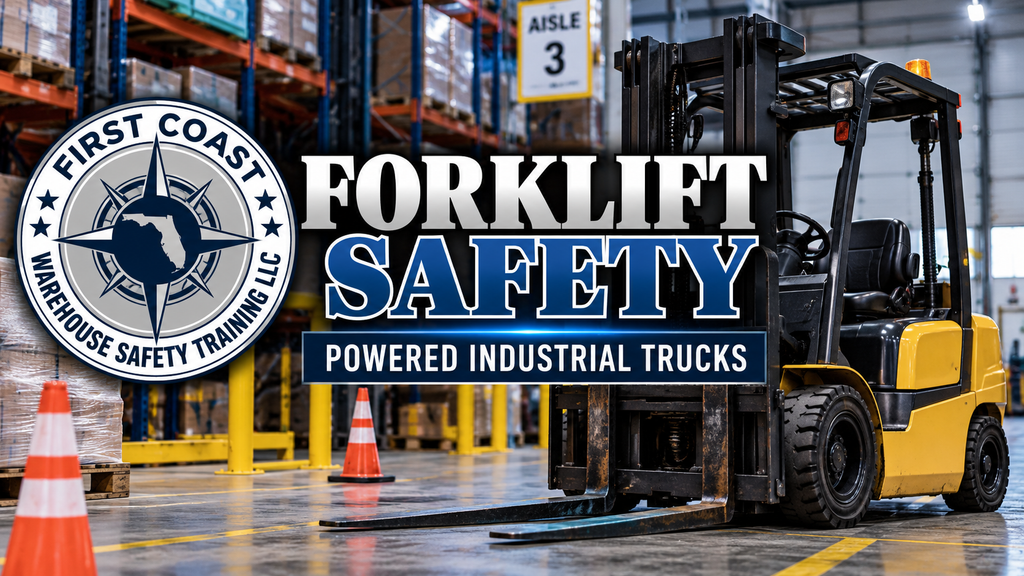
First Coast Warehouse Safety Training’s Forklift and Powered Industrial Truck (PIT) Safety Training course provides employees, supervisors, and employers with an understanding of safe equipment operation and OSHA requirements under 29 CFR 1910.178.
The course addresses common hazards associated with forklifts, reach trucks, electric pallet jacks, and other powered industrial trucks. Training emphasizes operator awareness, equipment inspections, load stability, pedestrian safety, and safe operating practices.
Our training approach incorporates industry-specific equipment knowledge, including Raymond material handling equipment and Yale powered pallet jacks.
What Students Will Learn
Upon completion of this course, participants will be able to:
- Understand OSHA requirements for powered industrial trucks under 29 CFR 1910.178.
- Identify different classifications and types of powered industrial trucks.
- Recognize hazards associated with counterbalanced forklifts, reach trucks, order pickers, and powered pallet jacks.
- Understand equipment stability, load centers, rated capacities, and the stability triangle.
- Recognize the importance of pre-operation inspections and identifying equipment defects.
- Understand safe load handling, stacking, unstacking, and material placement.
- Identify pedestrian hazards and appropriate traffic management practices.
- Recognize hazards associated with ramps, loading docks, trailers, and elevated surfaces.
- Understand safe travel practices, visibility requirements, and operating speeds.
- Recognize safety considerations associated with battery charging, refueling, and equipment maintenance.
- Understand OSHA requirements for operator training, evaluation, and refresher training.
- Explain employer and operator responsibilities for maintaining a safe working environment.
Equipment Covered
Training addresses safety principles applicable to various powered industrial trucks, including:
- Sit-down counterbalanced forklifts
- Stand-up forklifts
- Raymond reach trucks
- Order pickers
- Walkie stackers
- Yale electric pallet jacks
- Walk-behind and rider-type powered pallet trucks
- Other powered industrial trucks commonly used in warehouse and distribution operations
Equipment-specific instruction and practical evaluation requirements depend on the equipment operated and the employer’s workplace conditions.
Who Should Take This Course?
This training is intended for:
- Warehouse and distribution center employees
- Forklift and powered industrial truck operators
- Shipping and receiving personnel
- Manufacturing and production employees
- Material handlers
- Warehouse supervisors and team leaders
- Safety coordinators and managers
- Employers responsible for powered industrial truck safety programs
Instructor Qualifications and Training Experience
First Coast Warehouse Safety Training provides instruction supported by professional experience in warehouse operations, equipment safety, employee development, and OSHA General Industry safety requirements.
Instructor Robert Courtney Jr. holds OSHA General Industry Outreach Trainer authorization and brings operational training and supervisory experience to the classroom.
Raymond Train-the-Trainer certification is anticipated, further supporting equipment-focused instruction involving Raymond material handling equipment.
Training also addresses the safe operation of Yale powered pallet jacks and other commonly used warehouse equipment.
Applicable OSHA Standards
The primary OSHA standard addressed in this course is:
29 CFR 1910.178 — Powered Industrial Trucks.
Particular emphasis is placed on 29 CFR 1910.178(l), which establishes requirements for operator training, evaluation, refresher training, and certification of training and evaluation.
Employers must ensure operators are properly trained and evaluated before being authorized to operate powered industrial trucks in the workplace.
Course Completion and Certificate
Participants must complete the required online training material and successfully pass the final examination with a minimum score of 80%.
Upon successful completion, participants will receive a Certificate of Completion from First Coast Warehouse Safety Training.
Important: Completion of this online course does not independently authorize an individual to operate a forklift or other powered industrial truck.
OSHA requires operator training to include applicable formal instruction, practical training, and evaluation of the operator’s performance in the workplace. Employers remain responsible for ensuring these requirements are satisfied before authorizing equipment operation.
Practical Training and Employer Responsibilities
First Coast Warehouse Safety Training recognizes that effective forklift safety training extends beyond classroom instruction.
Employers must ensure operators demonstrate the ability to safely operate the specific types of powered industrial trucks used in their facilities.
Practical instruction and evaluation should address actual workplace conditions, equipment characteristics, pedestrian traffic, load handling, and operational hazards.
Training Services
First Coast Warehouse Safety Training provides workplace safety education and training support for businesses throughout Northeast and Central Florida and South Georgia.
Our goal is to help organizations develop knowledgeable operators, strengthen workplace safety practices, and reduce the risks associated with powered industrial truck operations.