OSHA Recordkeeping & Injury Reporting Safety Training
Course Overview
Accurate workplace injury and illness recordkeeping is an essential part of an effective occupational safety and health program. Employers must understand which incidents are OSHA recordable, when injuries and illnesses must be documented, and how to maintain records in accordance with federal regulations.
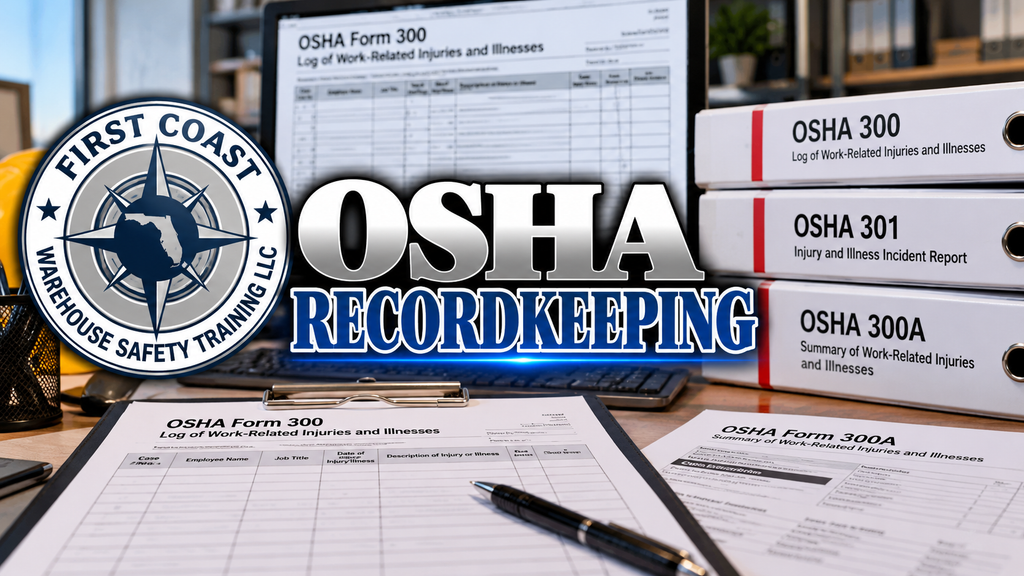
First Coast Warehouse Safety Training’s OSHA Recordkeeping & Injury Reporting Safety Training course provides employers, supervisors, safety professionals, and administrative personnel with an understanding of OSHA’s occupational injury and illness recordkeeping requirements under 29 CFR Part 1904.
This course examines the proper use of OSHA Forms 300, 300A, and 301, the criteria used to determine whether an injury or illness is recordable, and the difference between OSHA recordkeeping and severe injury reporting requirements.
Participants will learn how to evaluate workplace incidents, document recordable cases, maintain required records, and recognize common recordkeeping errors that can lead to compliance issues.
What Students Will Learn
Upon completion of this course, participants will be able to:
- Understand OSHA’s injury and illness recordkeeping requirements under 29 CFR Part 1904.
- Identify which employers are required to maintain OSHA injury and illness records.
- Distinguish between OSHA recordable injuries and illnesses and incidents that do not meet recording criteria.
- Apply OSHA’s general recording criteria, including medical treatment beyond first aid, days away from work, restricted work, job transfers, loss of consciousness, and significant diagnosed injuries or illnesses.
- Understand how to determine whether an injury or illness is work-related.
- Recognize the differences between first aid and medical treatment for recordkeeping purposes.
- Properly complete OSHA Form 300, Log of Work-Related Injuries and Illnesses.
- Understand the purpose and requirements of OSHA Form 301, Injury and Illness Incident Report.
- Prepare and understand OSHA Form 300A, Summary of Work-Related Injuries and Illnesses.
- Identify OSHA requirements for posting annual injury and illness summaries.
- Understand record retention and employee access requirements.
- Recognize OSHA’s severe injury and fatality reporting requirements.
- Understand electronic submission requirements for covered establishments.
- Identify common recordkeeping mistakes and methods for improving documentation accuracy.
Who Should Take This Course?
This training is intended for:
- Business owners and employers
- General Industry supervisors and managers
- Safety coordinators and safety managers
- Human resources personnel
- Operations managers
- Administrative employees responsible for OSHA records
- Warehouse and manufacturing management personnel
- Individuals responsible for workplace injury and illness documentation
Understanding OSHA Recordkeeping Forms
This course explains the purpose and proper use of OSHA’s three primary recordkeeping forms.
OSHA Form 300 — Log of Work-Related Injuries and Illnesses
Used to document individual recordable workplace injuries and illnesses, including case classifications and applicable days away from work, restricted work, or job transfers.
OSHA Form 300A — Summary of Work-Related Injuries and Illnesses
Provides an annual summary of recorded workplace injuries and illnesses.
Covered employers must post the annual summary from February 1 through April 30 of the following year.
The summary must be certified by a company executive as defined by OSHA.
OSHA Form 301 — Injury and Illness Incident Report
Provides additional information about individual recordable incidents, including the circumstances surrounding an injury or illness.
Employers may use an equivalent form if it contains the information required by OSHA.
OSHA Reporting Requirements
Participants will learn the difference between recording an incident on OSHA forms and reporting a serious workplace incident directly to OSHA.
Under federal OSHA requirements:
- Work-related fatalities generally must be reported within 8 hours of the employer learning of the fatality.
- Work-related inpatient hospitalizations, amputations, and losses of an eye generally must be reported within 24 hours of the employer learning of the event.
These reporting obligations may apply even when an employer is partially exempt from routine OSHA recordkeeping.
The course also explains the applicable reporting criteria and time limitations.
Electronic Recordkeeping Requirements
Certain establishments must electronically submit injury and illness information to OSHA based on establishment size, industry classification, and applicable reporting requirements.
Participants will receive an overview of OSHA’s Injury Tracking Application (ITA), electronic submission requirements, and the importance of accurate annual reporting.
Applicable OSHA Standards
The primary regulations addressed in this course include:
- 29 CFR 1904.4 — Recording Criteria
- 29 CFR 1904.5 — Determination of Work-Relatedness
- 29 CFR 1904.7 — General Recording Criteria
- 29 CFR 1904.29 — Forms
- 29 CFR 1904.32 — Annual Summary
- 29 CFR 1904.33 — Retention and Updating
- 29 CFR 1904.35 — Employee Involvement
- 29 CFR 1904.39 — Reporting Fatalities, Hospitalizations, Amputations, and Losses of an Eye
- 29 CFR 1904.41 — Electronic Submission of Injury and Illness Records
Course Completion and Certificate
Participants must complete the required training material and successfully pass the final examination with a minimum score of 80%.
Upon successful completion, participants will receive a Certificate of Completion from First Coast Warehouse Safety Training.
This course provides educational instruction concerning OSHA recordkeeping and reporting requirements. Employers remain responsible for determining their applicable obligations and maintaining accurate workplace injury and illness records.
Training Services
First Coast Warehouse Safety Training provides practical workplace safety education for employers, supervisors, and safety professionals throughout Northeast and Central Florida and South Georgia.
Our goal is to help organizations improve workplace injury documentation, understand regulatory responsibilities, and maintain effective occupational safety and health programs.